
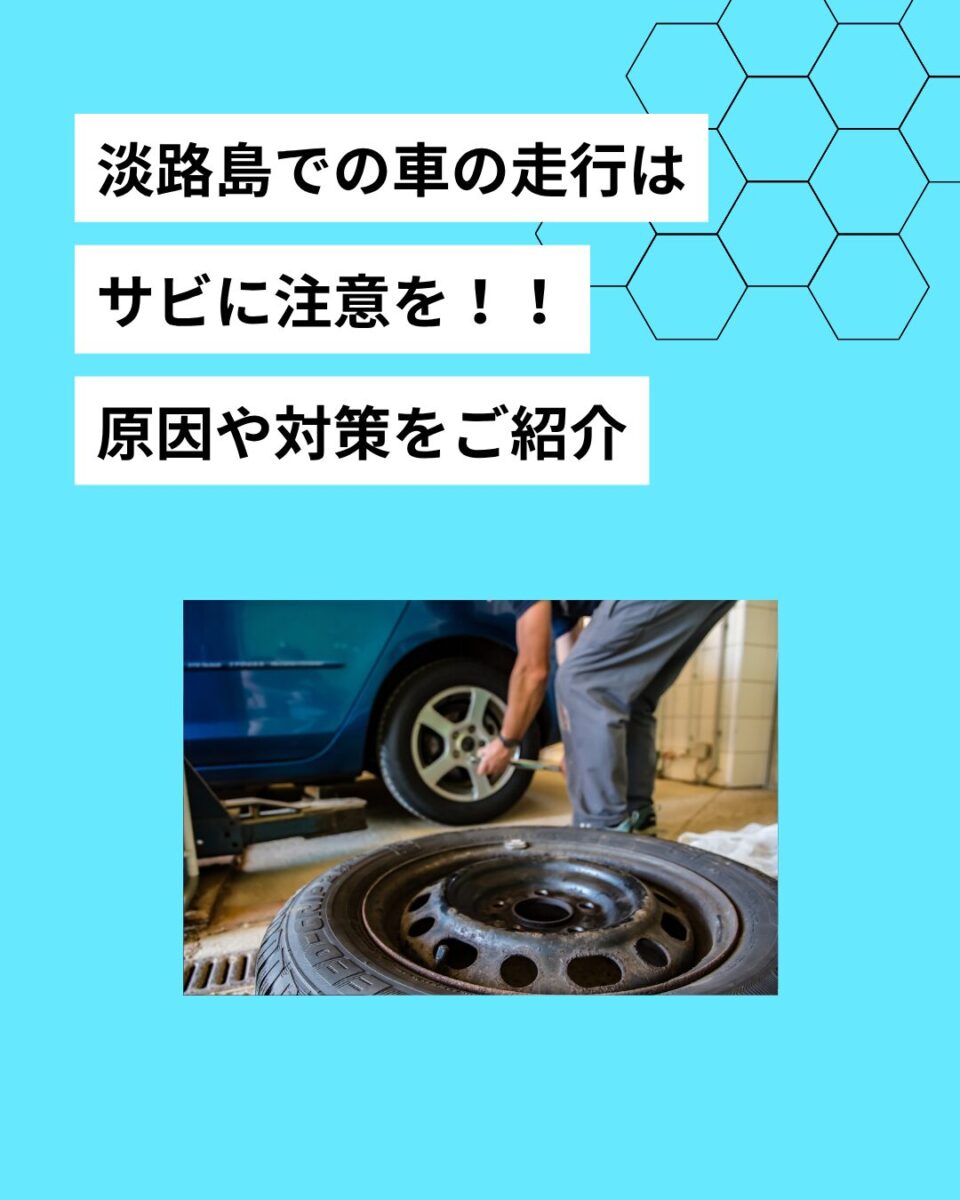
淡路島で車を運転していると、海沿いの道路を走る機会も多いのではないでしょうか。
美しい海を眺めながらのドライブは淡路島ならではの魅力ですが、車のメンテナンスという視点では、海風や塩分にも気を配っておきたいところです。
「海の近くに住んでいると車はサビやすいの?」
「海沿いを走った後は洗車した方がいい?」
「車の下回りは普段見えないけれど、サビていないか心配……」
このような疑問を持つ方もいるかもしれません。
海風に含まれる塩分は、車の金属部分がサビる原因の一つになります。ただし、淡路島に住んでいる車がすべてサビやすいというわけではありません。
海との距離や駐車場所、走行頻度、車の保管状態などによって影響は異なります。
今回は、淡路島の海沿いを走る車が知っておきたいサビの原因と、日頃からできる対策について解説します。
1. なぜ海沿いを走ると車がサビやすくなるの?
車のボディや下回りには、鉄などの金属部品が使われています。
金属は水分や酸素などの影響を受けると、サビが発生することがあります。
特に海の近くでは、海水が風によって運ばれることで、空気中に塩分を含んだ水滴や粒子が存在する場合があります。
こうした塩分が車に付着すると、金属部分の腐食が進みやすくなることがあります。
海風に含まれる塩分が車に付着する
海から吹く風には、海水由来の細かな塩分が含まれることがあります。
車で海沿いを走ったり、海の近くに駐車したりすると、ボディや窓ガラス、下回りなどに塩分が付着する可能性があります。
塩分が付着した状態で雨や湿気などの影響を受けると、金属部分の腐食につながることも…
サビはボディだけでなく下回りにも発生する
車のサビというと、ドアやフェンダーなど、目に見える部分をイメージする方が多いかもしれません。
しかし、注意したいのは普段見えにくい車の下回りです。
例えば、次のような部分はサビの状態を確認したい箇所です。
- 車体の下側にある金属部分
- サスペンション周辺
- マフラーなどの排気系部品
- 足回りの金属部品
- ボディ下部の接合部分
ただし、これらの部品すべてが同じようにサビるわけではありません。素材や表面処理、使用環境によって状態は異なります。
2. 淡路島の車はすべてサビやすい?
結論からいうと、淡路島で使用している車がすべてサビやすいとは限りません。
同じ淡路島内でも、海との距離や駐車環境、車の使い方によって塩分の影響は変わります。
例えば、次のような条件によって違いが出ることがあります。
海沿いを走る頻度
海沿いの道路を頻繁に走る車は、塩分が付着する機会が増える可能性があります。
一方、普段の走行場所が海から離れている場合は、影響の程度も異なると考えられます。
駐車場所や保管環境
屋外に長時間駐車する車は、風雨や湿気などの影響を受けます。
海に近い場所で駐車する場合は、風向きなどによって塩分が付着することもあります。
屋根付きの駐車場や車庫を利用していても、完全に塩分や湿気を防げるとは限りません。
車の使用頻度や手入れの状況
定期的に洗車をしているか、車体に汚れが残ったままになっていないかなども、車の状態を保つうえで大切です。
また、すでに塗装が傷ついている部分や、金属が露出している部分は、サビが発生する可能性があります。
大切なのは「淡路島だから必ずサビる」と考えることではなく、自分の車の使用環境に合わせて状態を確認することです。
3. 車のサビを防ぐためにできる3つの対策
サビは一度進行すると、状態によっては修理や部品交換が必要になる場合があります。
そのため、普段から汚れや塩分を落とし、車の状態を確認しておくことが大切です。
① 定期的に洗車して塩分や汚れを落とす
まず取り組みたいのが、定期的な洗車です。
海沿いを走った後や、海風にさらされたと感じる場合は、車体に付着した塩分や汚れを洗い流すことを意識しましょう。
洗車するときは、次のポイントを確認してください。
- ボディ表面の汚れを落とす
- ホイール周辺を洗う
- タイヤハウス内の泥や汚れを確認する
- 車の下側に付着した汚れも可能な範囲で洗い流す
特に下回りは、普段の洗車では汚れが残りやすい部分です。
下回りを洗浄する場合は、車両の取扱説明書や洗車設備の注意事項に従い、電装部品などに不適切な方法で水をかけないようにしましょう。
また、洗車後は水分が残りやすい部分にも注意し、必要に応じて水分を拭き取ることが大切です。
② 車の下回りを定期的に確認する
ボディの表面は目に入りやすいですが、下回りは普段なかなか確認できません。
しかし、サビ対策では下回りの状態を確認することも重要です。
例えば、次のような変化がないか注意しましょう。
- 金属部分に赤茶色のサビが見える
- 塗装や防錆処理が剥がれている
- 下回りに泥や汚れが固着している
- 以前よりサビが広がっているように見える
ただし、車の下に潜って確認するのは危険です。
ジャッキだけで車体を支えた状態で下に入ることは避けてください。見えにくい部分や判断が難しい部分は、整備工場などで点検してもらうと安心です。
③ 必要に応じて防錆処理を検討する
車の下回りには、防錆処理を検討できる場合があります。
防錆処理は、金属部分がサビるリスクを抑えるための対策の一つです。
ただし、すべての車に同じ施工が適しているわけではありません。
車種や下回りの構造、すでに発生しているサビの状態、使用環境などによって、適切な方法は異なります。
すでにサビが発生している場合は、単純に上から塗ればよいというものではありません。必要な下地処理や補修方法を確認することが大切です。
防錆処理を検討するときは、施工内容や対象範囲、使用する材料などを事前に確認しましょう。
4. こんなサビのサインを見つけたら要注意
車にサビが発生していても、初期段階では気づきにくいことがあります。
次のようなサインを見つけたら、一度状態を確認してみましょう。
ボディの塗装が浮いている
塗装が膨らんでいたり、剥がれていたりする場合は、塗装の内側で腐食が進んでいる可能性があります。
小さな変化でも、放置せずに状態を確認することが大切です。
ドアやフェンダー周辺に茶色い変色がある
ボディの端や接合部分などに茶色い変色が見られる場合は、サビが発生している可能性があります。
見た目だけでは判断できないこともあるため、気になる場合は点検を受けましょう。
車の下側にサビが広がっている
下回りの金属部分にサビが見られる場合は、表面だけの軽いサビなのか、腐食が進行しているのかを確認する必要があります。
特に、足回りや車体の重要な部分に腐食がある場合は、安全面にも関係する可能性があります。
異常を感じた場合は、早めに整備工場などへ相談してください。
5. サビ対策は洗車だけで十分?
洗車は塩分や汚れを落とすために役立ちますが、洗車だけですべてのサビを防げるわけではありません。
すでに塗装が傷ついている部分や、下回りの防錆処理が劣化している部分などは、別途確認や補修が必要になる場合があります。
また、車種によっては使用されている素材や防錆対策が異なります。
そのため、次のような考え方がおすすめです。
- 普段から洗車して塩分や汚れを落とす
- 下回りの状態を定期的に確認する
- 塗装の傷やサビを見つけたら放置しない
- 必要に応じて専門家に点検を依頼する
- 車種に合った防錆対策を検討する
車の状態を確認する機会として、定期点検や車検の際に下回りも見てもらうとよいでしょう。
6. 淡路島で車を長く乗るために大切なこと
淡路島では、通勤や買い物、家族でのお出かけなど、日常生活で車を使う機会がある方も多いでしょう。
車を長く使い続けるためには、エンジンやタイヤだけでなく、ボディや下回りの状態にも気を配ることが大切です。
特に海沿いを走る機会がある方は、普段の洗車や定期的な点検を習慣にしておくとよいでしょう。
また、サビは車の外側だけでなく、普段見えない部分で進行する場合もあります。
自分では確認しにくい部分については、整備工場などで状態を見てもらうことも検討してください。
淡路自動車は、兵庫県淡路市志筑にある自動車関連の事業者です。
創業53年、地域の皆さまに支えられながら営業してきました。
車の下回りやサビの状態など、気になることがあればお問い合わせください。
淡路自動車
📞 TEL:0799-64-0459
🏠 住所:兵庫県淡路市生穂1954
淡路市・淡路島で車のメンテナンスについて相談先をお探しの方は、お気軽にご相談ください。
LINEからもお気軽にお問い合わせください。
When driving on Awaji Island, you probably find yourself on coastal roads quite often.
Driving while taking in the beautiful ocean views is one of Awaji Island’s unique charms, but from a car maintenance perspective, it’s important to be mindful of the sea breeze and salt in the air.
“Does living near the ocean make my car more prone to rust?”
“Should I wash my car after driving along the coast?”
“I can’t usually see the underside of my car, but I’m worried it might be rusting…”
Some of you may have questions like these.
The salt in the sea breeze is one of the causes of rust on a car’s metal parts. However, this doesn’t mean that every car on Awaji Island is prone to rust.
The impact varies depending on factors such as distance from the ocean, parking location, how often you drive, and how the car is stored.
In this article, we’ll explain the causes of rust that drivers on Awaji Island’s coastal roads should be aware of, as well as preventive measures you can take on a daily basis.
1. Why Are Cars More Prone to Rust When Driven Along the Coast?
Metal parts, such as iron, are used in a car’s body and undercarriage.
When metals are exposed to moisture and oxygen, rust can form.
Especially near the ocean, seawater carried by the wind can result in salt-laden water droplets and particles in the air.
When this salt adheres to a car, it can accelerate corrosion of the metal parts.
Salt from the sea breeze adheres to the car
Winds blowing from the ocean may contain fine salt particles derived from seawater.
If you drive along the coast or park near the ocean, salt particles may adhere to the body, windows, undercarriage, and other parts of the vehicle.
If salt remains on the vehicle’s surface and is exposed to rain or humidity, it can lead to corrosion of metal parts…
Rust occurs not only on the body but also on the undercarriage
When people think of rust on a car, they often imagine visible parts like doors and fenders.
However, it’s important to pay attention to the undercarriage, which is usually out of sight.
For example, you’ll want to check the following areas for rust:
Metal parts on the underside of the vehicle
The area around the suspension
Exhaust system components, such as the muffler
Metal parts in the suspension system
Joints on the underside of the body
However, not all of these parts rust at the same rate. Their condition varies depending on the material, surface treatment, and operating environment.
2. Are all cars on Awaji Island prone to rust?
To put it simply, not all cars used on Awaji Island are necessarily prone to rust.
Even within Awaji Island itself, the impact of salt varies depending on the distance from the ocean, parking conditions, and how the car is used.
For example, differences may arise based on the following conditions:
Frequency of driving along the coast
Cars that frequently drive on coastal roads may have more opportunities for salt to accumulate on them.
On the other hand, if a car is typically driven in areas far from the ocean, the extent of the impact is likely to be different.
Parking Location and Storage Environment
Cars parked outdoors for long periods are exposed to wind, rain, and humidity.
If parked near the ocean, salt can accumulate depending on factors such as wind direction.
Even if you use a covered parking lot or garage, it doesn’t necessarily mean salt and humidity can be completely prevented.
Frequency of Use and Maintenance
Whether you wash your car regularly and whether dirt is left on the body are also important factors in maintaining your car’s condition.
Additionally, areas where the paint is already damaged or where metal is exposed are prone to rust.
The key is not to assume that “just because it’s Awaji Island, the car will definitely rust,” but rather to check the condition of your car based on its specific usage environment.
3. Three Measures You Can Take to Prevent Car Rust
Once rust sets in, depending on the severity, repairs or part replacements may be necessary.
Therefore, it’s important to regularly remove dirt and salt and check the condition of your car.
① Wash Your Car Regularly to Remove Salt and Dirt
The first step is to wash your car regularly.
After driving along the coast or if you feel your car has been exposed to sea breeze, make a point of rinsing off any salt or dirt that has accumulated on the body.
When washing your car, keep the following points in mind:
Remove dirt from the body surface
Wash around the wheels
Check for mud and dirt inside the wheel wells
Rinse off any dirt adhering to the underside of the car as much as possible
The undercarriage, in particular, is an area where dirt tends to remain even after a regular wash.
When cleaning the undercarriage, follow the vehicle’s owner’s manual and the safety instructions for the car wash facility to avoid spraying water on electrical components or other sensitive parts in an inappropriate manner.
It is also important to pay attention to areas where moisture tends to linger after washing and to wipe them dry as needed.
② Check the underside of the vehicle regularly
While the body’s surface is easy to see, the underside is not something you typically get to inspect on a daily basis.
However, checking the condition of the underside is crucial for rust prevention.
For example, watch for the following signs:
Rusty, reddish-brown spots visible on metal parts
Peeling paint or anti-corrosion coating
Mud or dirt caked onto the undercarriage
Rust that appears to have spread further than before
However, crawling under the car to inspect it can be dangerous.
Avoid getting under the vehicle when it is supported only by a jack. For areas that are hard to see or difficult to assess, it’s safest to have a repair shop inspect them for you.
③ Consider Rust Prevention Treatment as Needed
In some cases, you may want to consider rust prevention treatment for the underside of your vehicle.
Rust prevention treatment is one measure to reduce the risk of metal parts rusting.
However, the same treatment is not suitable for every vehicle.
The appropriate method varies depending on the vehicle model, the structure of the underside, the condition of any existing rust, and the operating environment.
If rust has already set in, simply painting over it is not the solution. It is important to confirm the necessary surface preparation and repair methods.
When considering rust prevention treatment, be sure to confirm the details of the work, the scope of application, and the materials to be used in advance.
4. Be Alert If You Notice These Signs of Rust
Even if rust has developed on your car, it can be difficult to notice in the early stages.
If you notice any of the following signs, take a moment to check the condition of your vehicle.
Peeling or blistering paint on the body
If the paint is bubbling or peeling, corrosion may be progressing beneath the surface.
Even with minor changes, it’s important to check the condition rather than ignoring them.
Brown discoloration around doors and fenders
If you notice brown discoloration along the edges of the body or at joints, rust may be present.
Since it’s not always possible to determine the extent of the problem by appearance alone, have your vehicle inspected if you’re concerned.
Rust spreading on the underside of the vehicle
If you see rust on the metal parts of the undercarriage, you need to determine whether it is just superficial rust or if corrosion is progressing.
In particular, corrosion in the suspension or other critical parts of the vehicle may pose a safety risk.
If you notice any abnormalities, consult a repair shop as soon as possible.
5. Is Car Washing Alone Enough to Prevent Rust?
While car washing helps remove salt and dirt, it alone cannot prevent all rust.
Areas where the paint is already damaged or where the underbody rust-proofing has deteriorated may require separate inspection or repair.
Additionally, the materials used and rust-prevention measures vary depending on the vehicle model.
Therefore, we recommend the following approach:
Wash your car regularly to remove salt and dirt
Check the condition of the underbody periodically
If you find paint scratches or rust, do not ignore them
Have a professional inspect the vehicle as needed
Consider rust prevention measures suited to your vehicle model
It’s a good idea to have the undercarriage inspected during routine maintenance or vehicle inspections as an opportunity to check the car’s condition.
6. Important Tips for Keeping Your Car Running Long on Awaji Island
On Awaji Island, many people rely on their cars for daily activities such as commuting, shopping, and family outings.
To keep your car running for a long time, it’s important to pay attention not only to the engine and tires but also to the condition of the body and undercarriage.
Especially if you often drive along the coast, it’s a good idea to make regular car washes and periodic inspections a habit.
Also, rust can develop not only on the exterior of the car but also in areas that are usually out of sight.
For areas that are difficult to check on your own, please consider having a mechanic at a repair shop inspect them.
Awaji Jidōsha is an automotive service provider located in Shizuki, Awaji City, Hyogo Prefecture.
We have been in business for 53 years, supported by the local community.
If you have any concerns—such as the condition of your car’s undercarriage or rust—please feel free to contact us.
Awaji Motor
📞 TEL: 0799-64-0459
🏠 Address: 1954 Ikio, Awaji City, Hyogo Prefecture
If you’re looking for someone to consult about car maintenance in Awaji City or on Awaji Island, please feel free to contact us.
Click here to contact us
Feel free to contact us via LINE as well.